

Why AI Creates New Business Risks
Traditional software generally operates within predictable boundaries. AI can be different.
Employees can submit information to AI systems, and AI assistants can retrieve information from business applications. AI agents can potentially interact with email, databases, files, APIs, cloud services, and other business platforms.
That creates opportunities for productivity, but it also creates opportunities for mistakes.
One of the most common AI risks is surprisingly simple:
Employees may share information with an AI platform that the organization never intended to share externally.
That information may include:
- Customer data
- Employee information
- Financial records
- Contracts
- Source code
- Intellectual property
- Regulated information
- Business plans
This is why AI is not simply an IT issue. It is a cybersecurity, data governance, compliance, and business risk issue.
The Goal Should Be Controlled Adoption, Not Fear
Organizations generally respond to AI in one of two ways:
- “Block it.”
- “Everyone should start using it.”
Neither is particularly effective.
Organizations that completely prohibit AI often discover employees are already using it independently. Organizations that encourage unrestricted usage may unintentionally introduce security, compliance, and governance challenges.
A more practical approach is establishing clear boundaries around:
- Which AI systems employees can use
- What information can be submitted
- Which systems AI can access
- What decisions AI can influence
- When human review is required
These are management decisions, not decisions individual employees should be expected to make on their own.
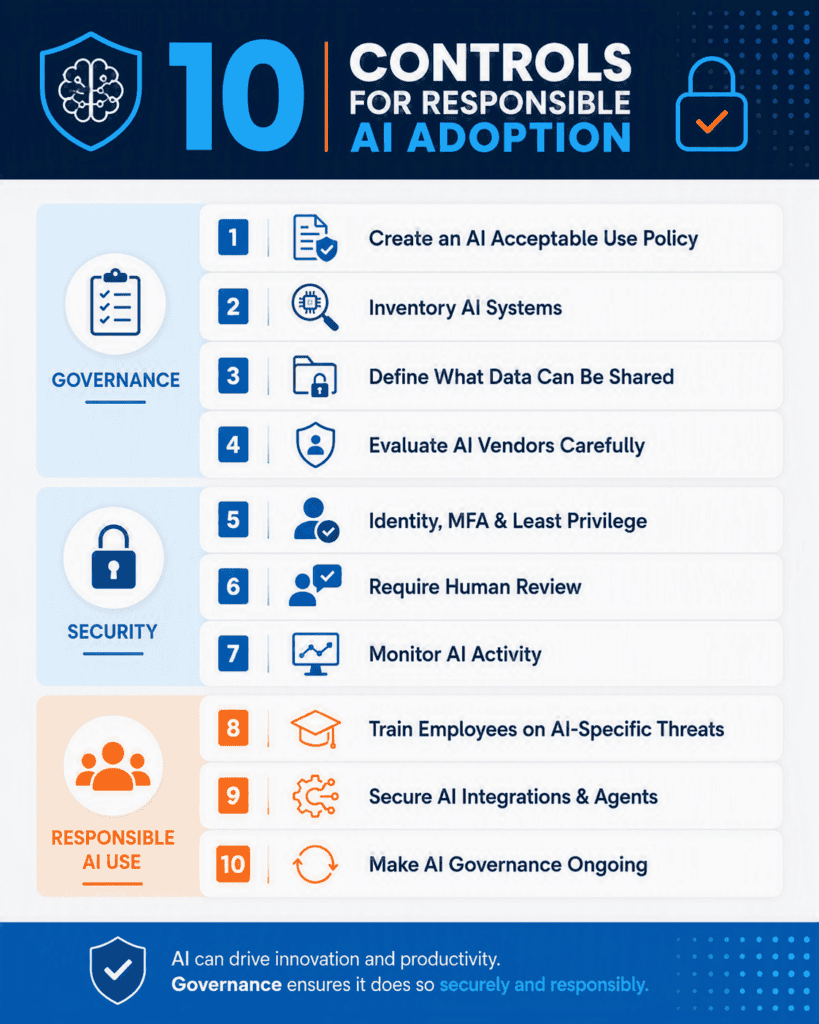
1. Create an AI Acceptable Use Policy
Employees need clear rules regarding approved AI tools, acceptable uses, restricted information, human review requirements, and approval processes for introducing new AI platforms.
2. Inventory AI Systems
Organizations cannot manage technology they don’t know exists.
This includes both standalone AI tools and AI capabilities embedded within existing software.
3. Define What Data Can Be Shared
Employees should understand the difference between public, internal, confidential, and regulated information.
A simple rule is often effective: If you wouldn’t send the information to an unknown third party, don’t submit it to an unapproved AI system.
4. Evaluate AI Vendors Carefully
Not every AI provider handles information the same way.
Organizations should understand the following before approving a platform:
- Data storage practices
- Retention policies
- Model training practices
- Security controls
- Encryption standards
- Access controls
- Contractual protections
5. Apply Identity, MFA, and Least Privilege
AI applications should not bypass existing security controls.
AI services should use centrally managed identities, multi-factor authentication, and role-based access controls whenever possible.
6. Require Human Review for Important Decisions
AI can generate impressive responses that are still incorrect.
Organizations should define scenarios where human review is mandatory, particularly for:
- Financial decisions
- Legal communications
- Security changes
- Employment decisions
- Customer commitments
- Safety-related decisions
AI should be treated as a capable assistant, not an unquestioned authority.
7. Monitor AI Activity
Organizations should determine what AI activity can be logged, monitored, and reviewed.
Monitoring may include:
- Logins
- Administrative changes
- Integrations
- Data access
- Agent activity
Automated actions AI activity should ultimately become part of broader security monitoring efforts where possible.
8. Train Employees on AI-Specific Threats
Traditional security awareness training is no longer enough.
Employees should understand risks such as:
- Sensitive data disclosure
- AI-generated phishing
- Prompt injection
- Unsafe AI-generated code
- Deepfakes
- Copyright concerns
- Inaccurate AI output
- Excessive trust in AI responses
AI literacy is now part of cybersecurity literacy.
9. Secure AI Integrations and Agents
The more systems AI can access, the greater the potential risk.
Organizations should carefully control:
- Permissions
- API access
- Integrations
- Automated actions
- Administrative capabilities
A useful principle is: The more an AI system can do, the less you should implicitly trust it.
10. Make AI Governance Ongoing
AI governance should not be a one-time project.
Organizations should regularly review:
- Approved AI applications
- Employee usage
- Vendor changes
- Security incidents
- Data handling requirements
- New integrations
- Emerging risks
Like cybersecurity, AI governance should follow a cycle of:
Assess. Implement. Monitor. Improve. Repeat.
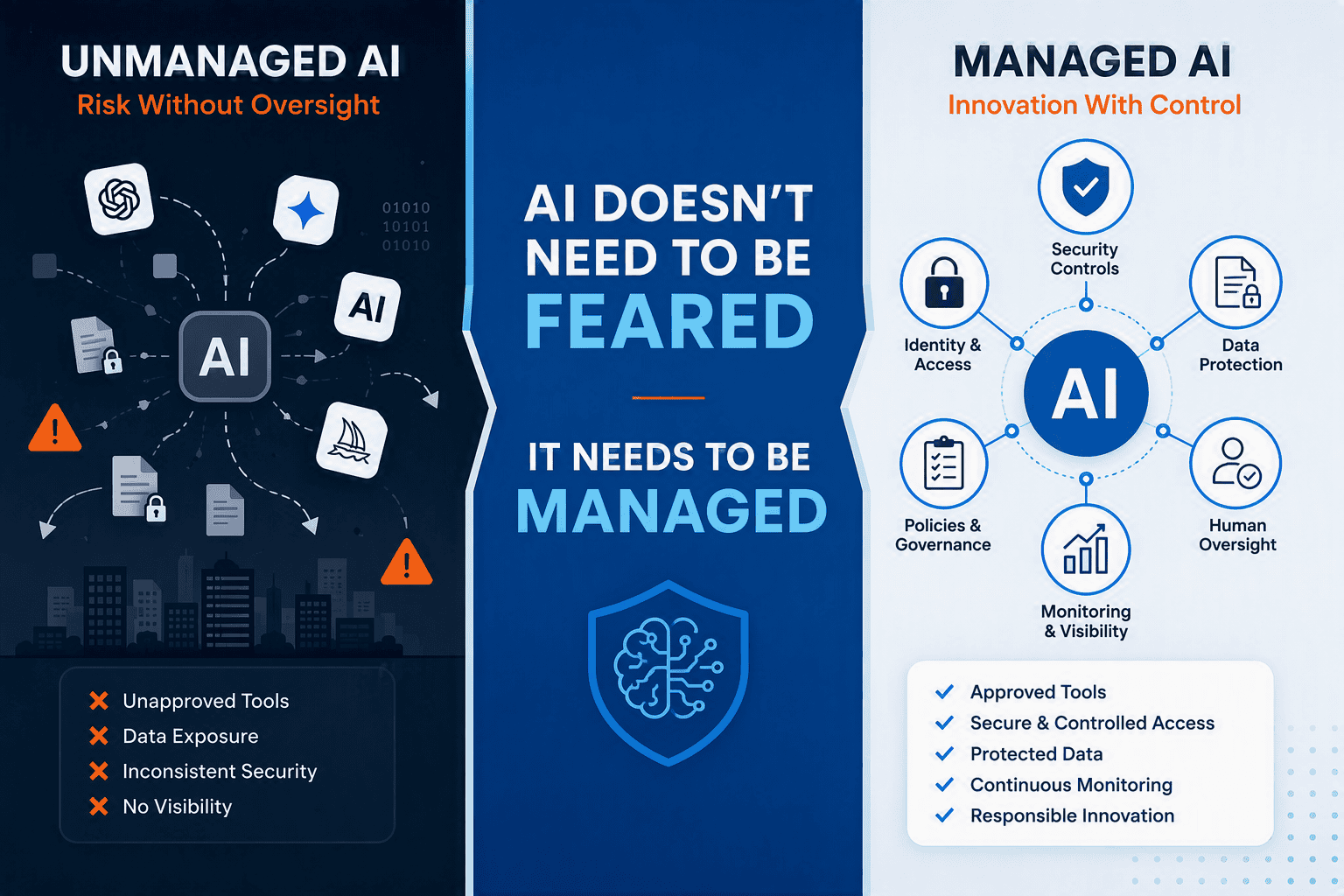
AI Doesn't Need to Be Feared. It Needs to Be Managed.
AI has the potential to improve productivity, strengthen decision-making, accelerate innovation, and automate repetitive work, and organizations should absolutely explore those opportunities.
However, powerful technology deserves appropriate controls.
The organizations that benefit most from AI will likely not be the ones that adopt every new tool the fastest. They will be the organizations that learn how to adopt AI deliberately, securely, and responsibly.
That means understanding which AI systems are being used, protecting sensitive information, controlling access, monitoring activity, reviewing vendors, and maintaining human oversight where it matters most.
Those concepts are not new. They are the same risk-management and cybersecurity principles that organizations have relied upon for years—adapted for a new generation of technology.
Is Your Organization Ready for AI?
Most businesses already have employees using AI in some form. The question is whether clear policies, security controls, and governance are in place to support that usage responsibly.
ACC can help your Central New York organization evaluate AI-related risks, establish governance frameworks, and align AI adoption with broader cybersecurity, compliance, and business objectives.