

Most organizations don’t think about IT risk assessments until something gives them a reason to. A cyber insurance renewal may require one, an upcoming audit may raise new questions, or a security incident may reveal a gap no one realized was there.
Technology risk rarely appears overnight. It develops as people, systems, applications, vendors, permissions, and business processes change. Regular assessments give businesses an opportunity to identify those risks before they lead to security incidents, compliance problems, downtime, or unnecessary costs.
So, how often should your organization conduct an IT and security risk assessment?
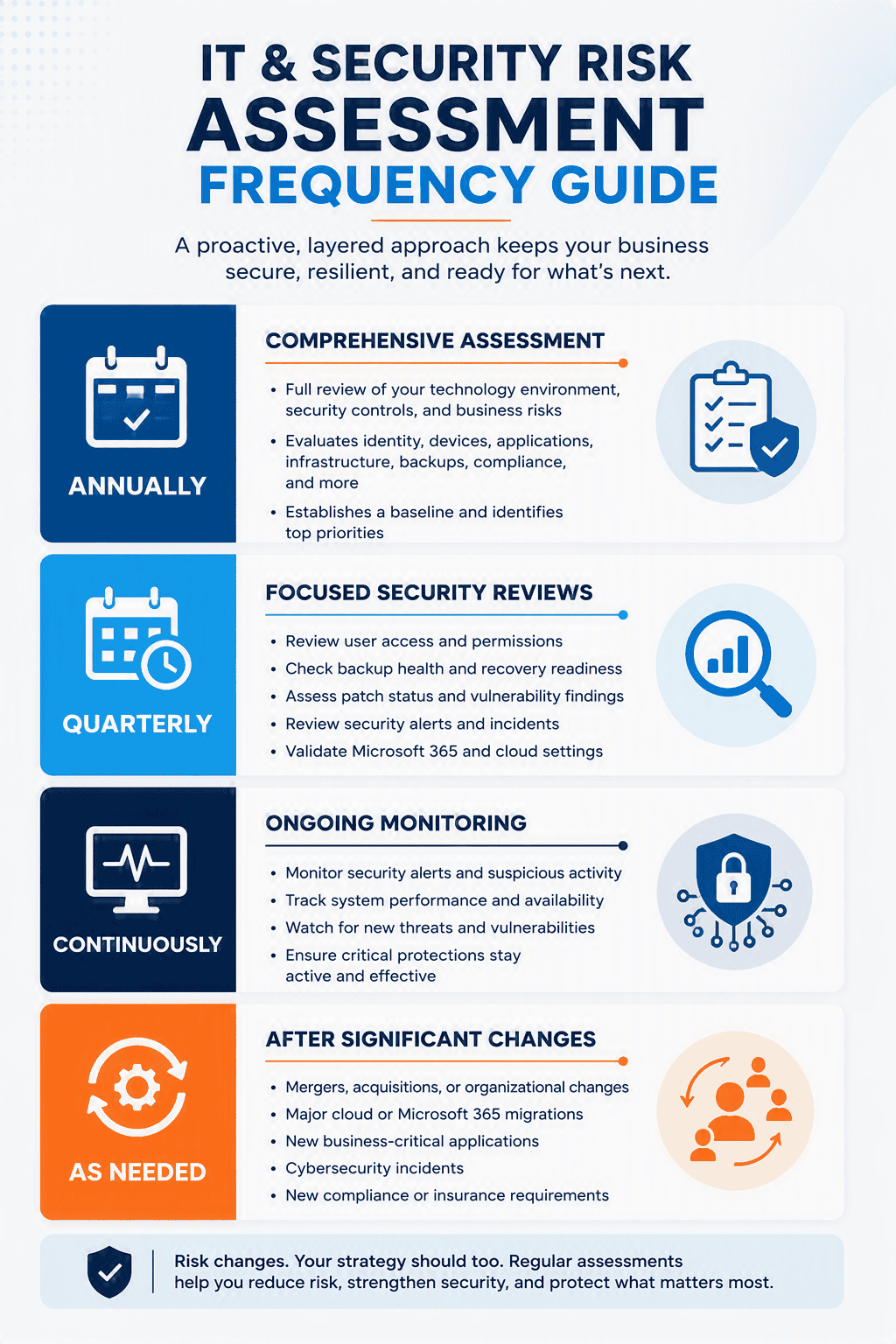
For most small and mid-sized businesses in Syracuse and Central New York, an annual comprehensive assessment is a practical baseline. It should be supported by focused reviews throughout the year, ongoing monitoring, and additional assessments following significant business or technology changes.
The right frequency depends on your industry, regulatory obligations, technology environment, rate of change, and level of risk.
What Is an IT and Security Risk Assessment?
An IT and security risk assessment is a structured review of your organization’s technology environment, security controls, processes, and business requirements.
Its purpose is to answer three fundamental questions:
- What could affect the confidentiality, integrity, or availability of your systems and data?
- How likely is that risk to affect the organization?
- What should be addressed first based on its potential business impact?
A comprehensive assessment may examine:
- User accounts, access, and permissions
- Identity protection and multi-factor authentication (MFA)
- Microsoft 365 and cloud configurations
- Endpoints, servers, and network infrastructure
- Vulnerability management and patch status
- Email and cybersecurity controls
- Backup and recovery readiness
- Business continuity planning
- Security policies and documentation
- Regulatory and contractual requirements
- Third-party applications and vendors
The goal is not simply to generate a list of technical problems. A good assessment helps leadership understand where risks exist, how those risks could affect the business, and which improvements should be prioritized first.
The NIST Guide for Conducting Risk Assessments describes three main steps: preparing for the assessment, conducting the assessment, and maintaining the assessment over time. Communicating results supports risk-informed decision-making throughout the process.
How Often Should an IT and Security Risk Assessment Be Conducted?
There is no single schedule that works for every organization. Most businesses benefit from combining annual assessments, more focused reviews, and ongoing monitoring.
Conduct a Comprehensive Assessment Annually
An annual assessment provides a broad review of your cybersecurity posture, technology environment, identity and access controls, Microsoft 365 settings, backup and recovery capabilities, compliance obligations, and business continuity readiness.
An annual assessment is a reasonable starting point, but it should not be the only time your organization evaluates risk.
Perform Focused Reviews Throughout the Year
Between annual assessments, shorter reviews help businesses monitor areas that change frequently.
Depending on the organization, these reviews may include:
- User access and administrative permissions
- New and inactive accounts
- Vulnerability findings and patch status
- Security alerts and incidents
- Backup status and recovery testing
- Changes to Microsoft 365
- Newly adopted applications
- Vendor access
- Progress on previously identified risks
A quarterly review is practical for many small and mid-sized organizations. Businesses with greater regulatory exposure or rapidly changing environments may need to review certain areas more frequently.
Consistency matters more than selecting a perfect date. A documented schedule is more effective than relying on someone to remember when a review is due.
Continuously Monitor Critical Risks
Some security risks should not wait for the next quarterly or annual review.
Suspicious sign-ins, backup failures, unauthorized account changes, vulnerable systems, newly disclosed vulnerabilities, and active security alerts may require immediate investigation.
An IT assessment provides a structured evaluation of the broader environment. Ongoing monitoring identifies activity and changes that require attention between assessments. Both are important, and one should not replace the other.
Additional Assessments May Be Needed After Significant Changes
Beyond annual assessments and quarterly reviews, businesses should consider an additional assessment whenever the environment changes significantly.
Examples include:
- A merger or acquisition
- An office relocation or expansion
- A significant staffing change
- A Microsoft 365 or cloud migration
- The implementation of a business-critical application
- A cybersecurity incident
- A major vendor change
- The adoption of AI tools
- A new regulatory or contractual requirement
- A material change in cyber insurance requirements
- A significant change in how employees access systems or data
These events can change who has access, where data resides, how systems connect, and which security controls are needed. Waiting until the next annual review may allow a newly introduced risk to remain unnoticed for months.
What Happens During an IT and Security Risk Assessment?
The process should be tailored to the organization, but a well-structured assessment generally includes four stages:
- Understanding the business and its requirements
- Reviewing the technology environment
- Evaluating controls and identifying gaps
- Prioritizing the findings based on business impact
ACC’s complimentary IT & Security Assessment provides a high-level overview of an organization’s current IT and cybersecurity posture. The discussion-based gap analysis helps identify areas that may not align with ACC standards, current security best practices, and the foundational safeguards associated with CIS RAM v2.2 for CIS Controls v8.1.
The result should be a practical roadmap, not an overwhelming list of technical observations.
The CISA Cyber assessments program similarly emphasizes using assessments to identify vulnerabilities, evaluate risk exposure, and improve an organization’s overall cybersecurity posture.
What Risks Do Businesses Commonly Overlook?
Many assessment findings are not caused by the absence of an expensive security tool. They result from everyday changes that were not consistently reviewed.
Excessive or Outdated Access
Employees may retain access after changing responsibilities. Former employee accounts may remain active, and administrative privileges may be broader than necessary.
Regular access reviews help ensure people have the access required for their work without retaining unnecessary permissions.
Inconsistent Identity Protection
Multi-factor authentication may be enabled for some employees but not others. Administrative accounts may not receive additional protection, and Conditional Access policies may be incomplete or inconsistently applied.
A compromised account can provide access to email, files, applications, and connected systems. Identity controls should therefore be a central part of the assessment.
Untested Backups
A dashboard may show that backups completed successfully, but that does not confirm the organization can restore critical systems within an acceptable timeframe.
A risk assessment should consider what is protected, how backups are secured, who can alter or delete them, and whether recovery has been tested.
Shadow IT and Third-Party Access
Employees may adopt applications, file-sharing platforms, or AI tools without formal review. Vendors may retain access to systems or information after that access is no longer required.
These accounts, tools, and integrations can create concerns involving security, privacy, ownership, compliance, and data retention. They should be included in regular technology and access reviews.
What Can Happen If You Skip Regular Assessments?
Skipping a risk assessment does not cause a cybersecurity incident by itself. It does make it more likely that important weaknesses will remain unidentified.
Those weaknesses can lead to:
- Unnecessary access to sensitive systems or data
- Security controls that are inconsistently configured
- Backups that do not meet actual recovery needs
- Undocumented applications and vendor connections
- Unpatched vulnerabilities
- Difficulty responding to customer security questionnaires
- Additional stress before audits or insurance renewals
- Technology risks leadership cannot clearly see or prioritize
The greatest cost is often uncertainty. Without a current assessment, leadership may be making technology, compliance, insurance, and budgeting decisions without a reliable understanding of the organization’s actual exposure.
How Do Risk Assessments Support Compliance?
A risk assessment and a compliance audit serve different purposes. A compliance audit evaluates an organization against specific requirements. A risk assessment examines threats, vulnerabilities, safeguards, and business impact.
Together, they help organizations prepare for audits, support compliance efforts, respond to customer and insurance requirements, and prioritize remediation activities.
The NIST Cybersecurity Framework 2.0 provides guidance organizations can use to understand and improve how they manage cybersecurity risk.
How Do You Know It Is Time for an Assessment?
Your organization may be ready for an assessment if:
- You have not completed one in the past year
- You are unsure who has access to sensitive information
- Your business has grown or changed substantially
- You have introduced significant cloud or Microsoft 365 changes
- You have not recently tested recovery procedures
- An audit, customer, insurer, or contract requires additional evidence
- You have experienced a cybersecurity incident
- Employees are adopting applications or AI tools without formal review
- Leadership cannot clearly identify the organization’s most important technology risks
You do not need to wait for a security incident to justify an assessment. Uncertainty about your current environment is a valid reason to take a closer look.
Get a Clearer View of Your IT and Security Risk
If your organization has not completed a recent IT and security assessment, or if your environment has changed significantly since the last one, ACC can help establish a clearer baseline.
ACC reviews the areas that affect day-to-day operations and long-term resilience, including identities, devices, Microsoft 365, infrastructure, cybersecurity controls, backups, recovery, and compliance considerations.